Our newest tool in the beekeeping kit: a solar wax melter. I made this based on plans I found online, with some modifications of my own. I put the finishing touches on this today and couldn't wait to try it out.
Even though it was cold today, about 47 degrees when I set it out, I thought it might warm up enough to give me some idea of what it could do. I left it in the sun, and when I came back 15, 20 minutes later, I opened it up, stuck my hand on the pan - and damn near burned it! Yes, it got that hot that quick.
Naturally, I had to give it a real test. So I put all the saved comb we had into the pan and watched carefully. It immediately started showing signs of melting, little bits tumbling down, slumping within the pile, it was very gratifying to see.
I left it to do its thing. When I came out a to check it a half-hour later, the clouds had rolled in and the sun was hidden. Drat. But I had seen enough to know that it would work, so I can't wait for a sunny day.
Thursday, March 22, 2018
Thursday, March 15, 2018
Hive Stand
We're getting ready for Spring. After a winter spent making new hive bodies and swarm traps, we're looking forward to catching more bees to fill them. But where to put them? There are all kinds of hive stands shown on the internet, so we had a lot of options. What we went with is fairly simple and straightforward, but should be sturdy and long-lasting.
These are treated two-by-eights sitting on concrete post supports. The crosspieces will keep the beams from wobbling. The gravel underneath is a ton-and-a-half of small trap rock from Burkdell mulch, delivered and unloaded by Ruth's daughter-law, Chrissy Strusz (Thanks, Chrissy!). Besides providing a solid, stable surface for the stand to sit upon, the gravel should help keep down the small hive beetles, a notorious pest in an apiary. Now we are ready to move our existing hives onto the stand, and fill in the space with all those new swarms we're going to catch.
One other feature of this stand is that the space between the boards is just right for supporting a frame when it is removed temporarily from the hive.
So what will we do if we fill all the space on this stand with hives? See that pile of blocks to the far right? They'll get pressed into service as hive stands again until we can make another addition to our apiary. Can't wait!
These are treated two-by-eights sitting on concrete post supports. The crosspieces will keep the beams from wobbling. The gravel underneath is a ton-and-a-half of small trap rock from Burkdell mulch, delivered and unloaded by Ruth's daughter-law, Chrissy Strusz (Thanks, Chrissy!). Besides providing a solid, stable surface for the stand to sit upon, the gravel should help keep down the small hive beetles, a notorious pest in an apiary. Now we are ready to move our existing hives onto the stand, and fill in the space with all those new swarms we're going to catch.
One other feature of this stand is that the space between the boards is just right for supporting a frame when it is removed temporarily from the hive.
So what will we do if we fill all the space on this stand with hives? See that pile of blocks to the far right? They'll get pressed into service as hive stands again until we can make another addition to our apiary. Can't wait!
Saturday, March 10, 2018
First Honey
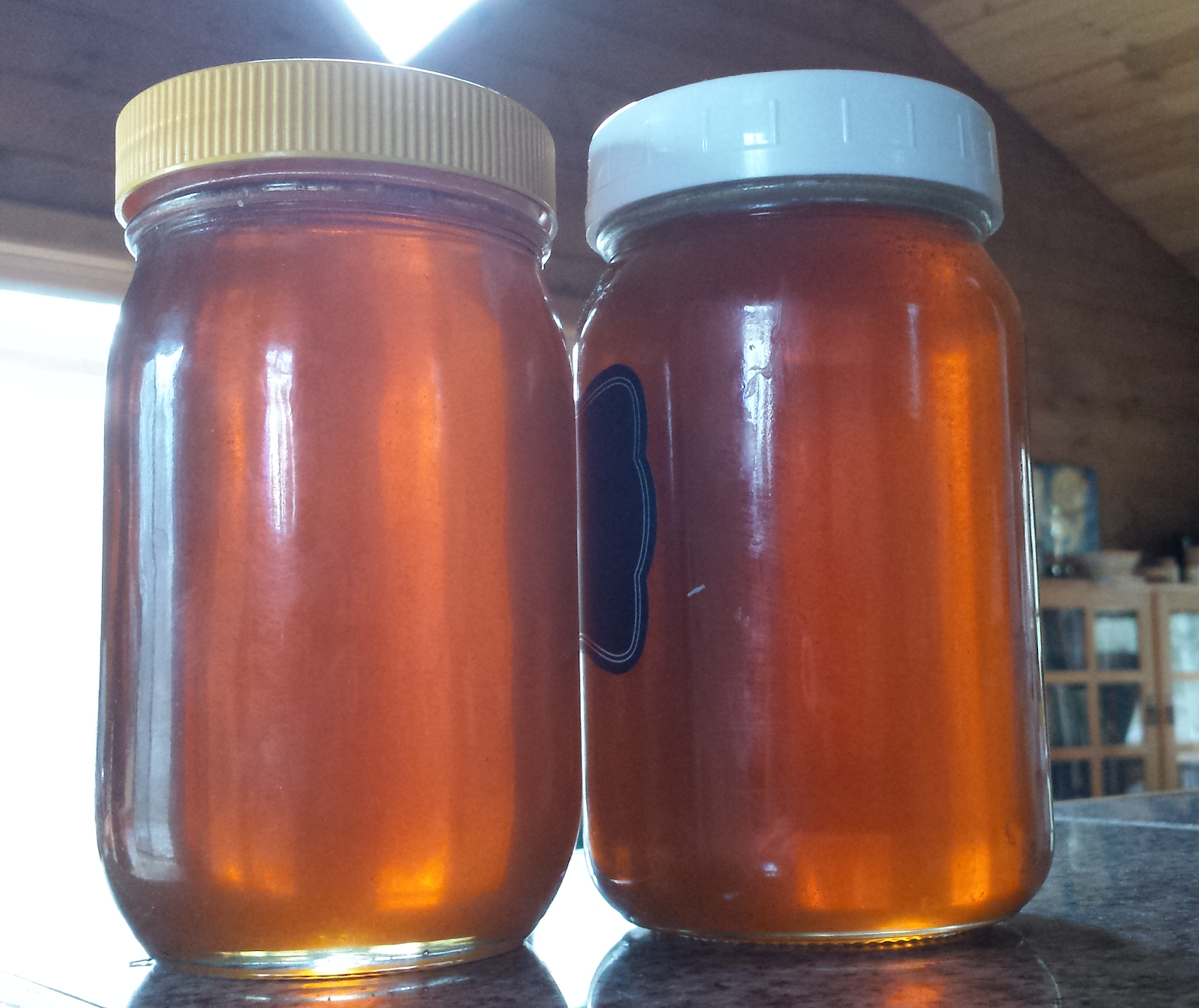
As I said in the previous post, we hadn't intended to take any honey from the hives, but changed our plans once we got in there. It's not a lot, only a couple of pints (plus another little dab that went into my oatmeal this morning), but it's ours! The picture really doesn't do it justice, but trust me, it's beautiful.
The wax from this is set out for the bees, so they can get at the residual honey that couldn't drain off. Once they've cleaned it up, we'll render it and save it to make things later.
I know, in the great scheme of the universe this is a pretty small thing. But we have this wonderful product coming out of boxes which were completely empty less than a year ago. There's something a little miraculous about this.
Monday, March 5, 2018
The Year's First Hive Inspection
Yesterday, Ruth and I did our first hive inspection of the
year. Beautiful afternoon, sunny,
breezy, a great day to get into the hives.
We’ve seen a lot of activity, lots of bees flying in and out, lots of
pollen going in for the past two weeks, but we’re still pretty new at this,
still not much experience, and we didn’t know what we were going to find once
we got in there.
Bees go through a lot of stores in the winter, and though we
had left them everything they made last year, there was still the fear that
they might be running low on honey. It
wouldn’t have surprised us at all to find lots of empty frames inside the hive.
Imagine our surprise to find the boxes nearly full of
honey! Apparently, the bees had had
plenty to eat, and were already starting to pack it away again. Lots of honey, a fair amount of nectar, and
best of all, lots of fresh brood in a very good pattern. That means the queen in each hive is
thriving, already hard at work laying eggs and making new bees. It was very reassuring to see the colonies booming.
Though we hadn’t expected to, we wound up taking some of the
honey from the hives. We’re trying to go
foundationless, meaning that instead of a sheet of plastic in each frame upon
which the bees build their comb, we have an empty frame with a comb guide at
the top to encourage the bees to build straight comb within the frame. Unfortunately, the bees didn’t have a ruler
inside the hive, and some of their comb ranged over two or three frames. We carefully cut the errant comb loose, arranged
it to fit within a single frame, and used rubber bands to hold it in place
until the bees can reattach it. In some
cases, the comb was so wonky (the technical term) that we wound up just cutting
it off and tossing it in a bucket along with the burr comb. We had enough by the end that we will have to
work a bit to extract it, and we’ll wind up with several pounds of fresh
honey.
All in all, it was a very satisfying day. The bees look great, and we seem well on our
way to a successful bee season. We’re
already looking forward to swarm season, catching more bees, and growing our
nascent apiary. And we can’t wait until
we can make our lip balms and lotion bars with beeswax from our own hives.
Stay tuned.
Thursday, February 22, 2018
Maple Syrup Festival, Touch of Nature
It looks to be a busier spring for us than we normally have. Typically, we don't have any shows until the fall season starts, and now it looks as if we'll be out and about a bit more than usual.
Our first event will be the Maple Syrup Festival at SIU's Touch of Nature, 1206 Touch of Nature Rd, Makanda, Illinois. Saturday looks as if it will be warm and wet, Sunday cooler, but clear and sunny.
We will be down the hill a bit from the building where the pancake breakfast is served, so you might have to to hunt for us a bit, but I promise it will be worth it.
We'll have information on more shows as the plans firm up. Till then, keep an eye on this space.
Our first event will be the Maple Syrup Festival at SIU's Touch of Nature, 1206 Touch of Nature Rd, Makanda, Illinois. Saturday looks as if it will be warm and wet, Sunday cooler, but clear and sunny.
We will be down the hill a bit from the building where the pancake breakfast is served, so you might have to to hunt for us a bit, but I promise it will be worth it.
We'll have information on more shows as the plans firm up. Till then, keep an eye on this space.
Thursday, January 25, 2018
Winter Bees
After the recent cold snap with temperatures down in the single digits for far too long, it's nice to have more temperate weather. This week, with highs in the 40's and 50's, sunny skies, and gentle breezes, the bees have been out again.
Bees hole up in their hives when the bitter weather comes, clustering together to keep warm. Even the recent lows don't seem to have bothered them. After a few million years, they've got the hang of dealing with adverse conditions.
It's been a joy to see them out and about. It's still far too early for them to go foraging for nectar, as the first blooms are still a few weeks away. But since bees won't defecate in the hive, and won't fly when it's too cold, they need these warm days to go out and relieve themselves in what are called "cleansing flights." They also take advantage of these warmer days to clear the hive of dead bees. Though it can be a bit alarming to see a bunch of dead bees on the porch of the hive, it is actually a reassuring sign that the bees are still thriving and taking care of business. A weak or dead hive would simply let the dead bees lay; by carrying them out, they show that they are still taking care of business.
Soon the first flowers of the season will appear. We'll start seeing the crocuses that have survived the moles. For the first time, I'll be able to look at dandelions in the yard with a smile rather than a sigh. Then the bees will really kick into high gear, a steady stream leaving and entering the hive, bringing back their loads of nectar and pollen. It's a happy sight and a happy sound, one I am very much looking forward to. For now, I'm enjoying the early flights of the bees as they take wing on these respites from winter.
Bees hole up in their hives when the bitter weather comes, clustering together to keep warm. Even the recent lows don't seem to have bothered them. After a few million years, they've got the hang of dealing with adverse conditions.
It's been a joy to see them out and about. It's still far too early for them to go foraging for nectar, as the first blooms are still a few weeks away. But since bees won't defecate in the hive, and won't fly when it's too cold, they need these warm days to go out and relieve themselves in what are called "cleansing flights." They also take advantage of these warmer days to clear the hive of dead bees. Though it can be a bit alarming to see a bunch of dead bees on the porch of the hive, it is actually a reassuring sign that the bees are still thriving and taking care of business. A weak or dead hive would simply let the dead bees lay; by carrying them out, they show that they are still taking care of business.
Soon the first flowers of the season will appear. We'll start seeing the crocuses that have survived the moles. For the first time, I'll be able to look at dandelions in the yard with a smile rather than a sigh. Then the bees will really kick into high gear, a steady stream leaving and entering the hive, bringing back their loads of nectar and pollen. It's a happy sight and a happy sound, one I am very much looking forward to. For now, I'm enjoying the early flights of the bees as they take wing on these respites from winter.
Wednesday, January 17, 2018
Farewell, Nest
Nest Arts in downtown Carbondale has carried our products almost from their beginning when it opened as Dayshift. For many years they have been a good and dependable store, and we have enjoyed a warm relationship with them for all this time.
Thus, it is with sadness that we learned of Nest closing. Owner Chris McKinley has made a valiant effort, and has done a great job. But she has had an uphill climb all the way, offering local, handcrafted art to a mass-market audience.
We will miss Nest, which, with the closing of Anthill Gallery in Cobden, leaves few outlets for local artists. I understand Chris will likely remain in the area, however, so we won't lose her creative spark. Ruth and John thank her for all she has done, and wish her nothing but the best in all that is to come.
Thus, it is with sadness that we learned of Nest closing. Owner Chris McKinley has made a valiant effort, and has done a great job. But she has had an uphill climb all the way, offering local, handcrafted art to a mass-market audience.
We will miss Nest, which, with the closing of Anthill Gallery in Cobden, leaves few outlets for local artists. I understand Chris will likely remain in the area, however, so we won't lose her creative spark. Ruth and John thank her for all she has done, and wish her nothing but the best in all that is to come.
Subscribe to:
Posts (Atom)


.jpg)